Dan Olinger

"If the Bible is true, then none of our fears are legitimate, none of our frustrations are permanent, and none of our opposition is significant."

Dan Olinger


Retired Bible Professor,

Bob Jones University

home / about / archive 

Subscribe via Email

On Threats from a Hostile Culture

January 25, 2018 by Dan Olinger 2 Comments

Last week Carl Trueman published a thoughtful piece, entitled “Preparing for Winter,” on the future of Christian colleges. His premise is that they’re threatened, existentially threatened, by the hostile secular culture, particularly as it is expressed by the US government, and particularly in the matter of sexual discrimination, and particularly on the question of transgenderism. If Christian colleges stick to their beliefs, they will run afoul of anti-discrimination laws, thereby losing their accreditation and possibly—probably—even their tax exemption. An existential threat.

I don’t find anything he said directly wrong, but I’d like to balance his thoughts just a little bit.

First, a key piece of his argument is the Bob Jones Supreme Court case, in which my college lost its tax exemption because it violated “public policy” by prohibiting interracial marriage among its students. Something he doesn’t seem to consider, though, is that public-policy decisions arise more out of politics than out of law. It was easy for most Americans to agree with the court’s decision in the Bob Jones case because BJU was, well, wrong. It seems to me that if the government were to seriously consider denying tax exemption to all Christian schools that do not accommodate the policy du jour on transgenderism, the breadth of public outcry, and the consequent threat of political backlash, would render such an incursion politically impossible. There are a lot of people in this country who don’t see current transgender policy as in the same category as the civil rights movement.

There’s a reason that Social Security is the third rail of politics, even though the math underlying it is confessedly bogus. Politics works that way.

But times change, and majority public opinion changes with it. Suppose that, over time, clear biblical teaching on sexual morality is seen by most Americans as the enemy of the people? What then?

Well, several observations.

First, colleges can survive without tax exemption. Bob Jones did (and yes, it got the exemption back after several decades). It’s difficult, and with the passage of time a college will need to change significantly in the way it does things and perhaps even in its basic structure, methods, and size. But people are in the image of God, and that fact makes them creative, among other things. Just as businesses adjust to changes in tax law and all sorts of other elements in their legal environment—and do that every year, routinely—so people who want to run an educational institution can come up with ways to make it work. (And toward the end of his piece, Trueman essentially says that.)

But suppose the environment gets so oppressive that the college model can’t work at all? Well, for most of human existence—and this is true for young-earth creationists as well as old-earth creationists—people have been educating their offspring and preparing them for useful lives without any colleges whatsoever. You think businessmen are creative? Just watch parents trying to ensure their children’s success. There are no limits.

And it’s not just about the motivation and determined action of the parents.

For decades the People’s Republic of China was one of the most oppressive societies on the planet. It was completely cut off from the West; everybody had to dress just like Chairman Mao, and they had to quote his Little Red Book; and Mao had unfettered power to annihilate the scourge of Christianity from his land.

Several years ago I was teaching Christian theology. After class one of the students, who had grown up in China, said to me, “You are telling the [Bible] stories.” “Yes,” I replied. “I know the stories,” she said. “How do you know?” “My grandmother taught me.”

Mao had all the power imaginable, and he used all of it. Millions of his own people died under his orders just because they were Christians. But today Mao is dead—I’ve seen his corpse—and his great effort was foiled by a bunch of wizened 4’10” Chinese grandmothers, who told their grandchildren the stories. And today, by most estimates, there are more Christians in China than there are in the US.

Christian parents of whatever nation, however hostile, will tell those same stories, and Christian sons and daughters will go out as ambassadors for Christ, to spread the Good News, to die if necessary, but they will go out, and they will be faithful.

Christ, whose power well exceeds that of Mao and of any future American autocrat, will build his church, and the very gates of hell will have nothing at hand to stop it.

Fear not.

Photo by Cole Keister on Unsplash

Filed Under: Culture, Politics, Theology Tagged With: freakoutthounot, politics

On Leaders, Flaws, and Achieving Some Sort of Rational Consistency

January 15, 2018 by Dan Olinger 4 Comments

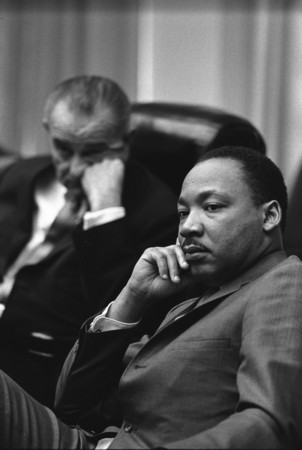
Today is Martin Luther King Day. Or, as the government officially calls it, the “Birthday of Martin Luther King, Jr.” On this day the nation officially focuses on a lesson learned from its past; as the current president put it, to “encourage all Americans to observe this day with acts of civic work and community service in honor of Dr. King’s extraordinary life — and it was extraordinary indeed — and his great legacy.”

We all know that this day, and its good intentions, arose out of controversy—first, the very painful controversy surrounding the Civil Rights movement, and then more controversy regarding the personal character of Dr. King himself.

Political conservatives, in my opinion, pretty badly missed the boat in dismissing the Civil Rights movement as simply “communist agitation,” first, because it sprang from a serious social problem in our culture and was not simply a minor issue stirred up by enemies of the nation to foment instability. Of course the extreme left sought to use the movement for its own very different ends, but that minor fact hardly renders racial segregation and discrimination minor problems. Both political and religious conservatism are founded solidly on the principle of divine creation of all humans and the rights and respect that come with that status. Conservatism speaks often of equal justice under law. We conservatives missed the boat—badly—on this one. We took the wrong side.

And then there’s the second controversy. When Congress discussed making Dr. King’s birthday a federal holiday, there was considerable opposition. Some of it, doubtless, came from those who just don’t like black people. Further opposition came from those on the political right who didn’t like anybody aligned with the political left. But some opposed the holiday on the ground that Dr. King was a flawed character, one whose birthday we shouldn’t honor with a federal holiday.

Charges were leveled against his memory. The most significant was that he had been unfaithful to his wife. Some charged, based on his acceptance of support from left-wing organizations, that he was a communist. Others noted that while he preached non-violence, violent protests seemed to follow him wherever he went. The character argument received new life several years after President Reagan signed the holiday into law in 1983, when Dr. King was found to have plagiarized his doctoral dissertation in systematic theology at Boston University in 1955.

Can we celebrate a holiday as an impetus to social good, based on the noble sentiments expressed in the “I Have a Dream” speech, when the man who gave it was imperfect? Well, obviously we can; that’s what we’re doing. More precisely, then, can we do so in a way that’s morally and intellectually consistent?

I think we can. Here’s why.

First, everyone is flawed. That doesn’t mean that everyone’s birthday should be a national holiday, but it does mean that all of our heroes—all of them—have feet of clay. Washington, Lincoln, the Pilgrims, our veterans, even St. Valentine!—these are people who sinned and who disappointed themselves and others along the way. But they did not surrender to their sinful natures; they rose, as image-bearers of God, to stand for ideas that were bigger than themselves, ideas that are worth celebrating and promoting.

The real question, then, is whether Dr. King did the same, in spite of his status, alongside all of us, as a sinner.

That’s a question we have to wrestle with in each of our proposed heroes. In the case of Dr. King, I don’t know whether he was unfaithful to his wife; I don’t know whether he secretly sought to promote violence even as he urged the opposite; I don’t know whether he was an ideological communist—though I’m pretty sure, based on statements and his actions, that he wasn’t. I’m not going to believe those things about him without better evidence than I have, and I’m especially not going to believe those accusations when they come only from his avowed enemies.

Now, the plagiarism matter was adjudicated by a panel at his alma mater, and they ruled that he was guilty. In my line of work, that’s a career ender, but there are all kinds of mitigating considerations along the way—intent and extent being the most significant—and I’m not in a position to know the details of those matters either.

So what do we have? We have an imperfect man who embraced and promoted high ideals—necessary and good ideals—at significant personal risk, who inspired a great many people to pursue those ideals themselves, whose legacy is directly associated with those ideals, and whose memory is sacred to a lot of people, all of whom are in the image of God, and many of whom are my dear friends and colleagues, of whose character I have no doubt.

Can I celebrate this day and the ideals with which it is associated?

You bet I can.

Photo Credit: Yoichi R. Okamoto

Filed Under: Culture, Politics Tagged With: holidays, sin

Freak Out Thou Not. This Means You.

January 8, 2018 by Dan Olinger 10 Comments

What to do?! What to do?!

Everything’s just awful! Worse than ever before!

If you’re conservative, then the Deep State is trying to overthrow a duly elected president, and the country’s going broke, and sexual mores are all being redefined, and what has happened to our country?!

And if you’re liberal, well, do we even need to say? We have an idiot in the White House, who watches TV all day, and he’s going to start a nuclear war, and even his entire staff thinks he’s unfit for office. Roll out the 25th and stop this madman.

It’s awful. Just awful.

I’m not suggesting that the world’s problems aren’t serious, or that evil people aren’t up to something. But I’d like to suggest that we don’t have to panic—in fact, that as a moral matter we ought not to panic.

A few observations.

One of the benefits of being an old codger is that, if your long-term memory is still working, you have some history by which to evaluate the present. I can testify that this kind of apocalyptic talk has been going on for as long as I’ve been alive—and longer than that (because I was actually taught history in school, back in the day).

When I was born, VP Richard Nixon was going to jail everybody who disagreed with him, because of that awful Senator McCarthy and the military-industrial complex, or something. Then JFK was going to start a nuclear war with the USSR over a few pictures from an inconsequential island. Then the Commies were going to destroy our society with forced integration, and with that take over the whole bloomin’ country by 1973. Then LBJ was going to kill all our boys in Vietnam—he was so unpopular with his own party that he couldn’t run for reelection in 1968. Then MLK and RFK were gunned down right before our eyes. Then Nixon—well, Nixon—do we even have to talk about him? End-of-the-world stuff. Then Carter couldn’t get our hostages out of Iran, and then Reagan was going to start World War III (“we begin bombing in five minutes!”), and then Clinton was, well, inattentive to his presidential duties because of, um, distractions, and there was that whole impeachment thing, which was just about sex, and who cares about that? and then Bush stole the whole country from Gore and blew up the Middle East by lying about WMDs, and then Obama wasn’t even born here, and was just an undercover Muslim (did you know his real name is Soetero?!), and threw the whole country away, and now Trump’s gonna destroy everything for sure.

I mean it when I say that I’m not mocking past fears or trivializing serious issues in the US and the world. But I can’t help noticing that none of the fears were realized. None of them. Sure, there are problems today, many of which have their roots in those earlier times. But we’re still here, and the great majority of us live better than millionaires did a hundred years ago (sometime study the history of sewage systems), and the fears were all overblown. All of them.

Political opponents have always exaggerated the fears. The current election has always been the Most Important One Ever, and the opponent has always been the Worst Person in the World. Now even the weather is worse than ever; every storm is the Storm of the Century, or the Snowpocalypse, or the Polar Vortex, or the Bomb Cyclone.

We need to get over our addiction to adrenaline. We need to see things as they really are, and then we need to just calm down.

This is particularly true of Christians. There is a God in heaven, who raises up kings—all of them—and in his good time sets them down again (Dan 2.21). Richard Nixon, Jimmy Carter, Ronald Reagan, and Bill Clinton are no longer any threat.

Further, they were never any threat to the plan of God, even when they were in office. They were, in fact, part of his plan. As is Donald Trump, love him or hate him, and Barack Obama before him. Our times are in the hands of a God who is both great and good, and whose intentions for his people are good to the infinite extreme.

What are seekers to think when God’s people act as though none of that is true? When they express dismay, or rage, or outright panic in their public proclamations or in private? When they evidence that for them, love of God has not cast out fear? When we show no evidence of grace, mercy, and peace?

Sure, the world’s a difficult and dangerous place. And when we see problems, they should get our attention, and we should act to solve them. We should fight injustice. We should demand truth and righteousness from our elected leaders. But we cannot act strategically, wisely, when we’re in panic mode. We need to be calm, rational, deliberate, trusting in the providential care of Almighty God, as we seek to bring light and hope to a badly broken world.

#freakoutthounot


Filed Under: Culture, Politics, Theology Tagged With: freakoutthounot

Amateur Thoughts on a Theatrical Experience

November 20, 2017 by Dan Olinger 1 Comment

Last week I had the pleasure of performing in a minor role in BJU’s Classic Players production of Shakespeare’s Much Ado about Nothing. I’ve enjoyed being able to act in a few other productions as well for the past couple of decades. (My first real acting experience, beyond the occasional skit, was in my 40s, when a friend offered me the role of Grumio in The Taming of the Shrew. I knew nothing about acting, and he kindly and patiently directed me to the point where I wouldn’t make a complete fool of myself—and him. Thanks, Ron.) This one was directed by my long-time friend and colleague, Dr. Lonnie Polson (“Rehearsal is not where I tell you what to do; it’s where you show me what you have already done”).

I love everything about the experience. The rehearsal hours are long and sometimes tedious, but that’s the price of getting to the point where you don’t fear complete chaos on opening night. And in those rehearsals I get to watch real actors work, experimenting with different ways to say their lines and deciding what kinds of body language and business make the role genuine. Then there’s the work of the crew, including costumers who make an idea real and attentively see that the costume fits the actor in such a way that he can do what he needs to do on stage; makeup artists, who spend significant time creating art that’s going to last for just a couple of hours, but in the meantime transform actors into exactly the people they need to be; and wig & hair artists, who complete what the makeup artists have begun with what amounts to the cherry on top. And during performance, the crew is standing in the wings, ready to fix anything that goes wrong in their area of responsibility.

And we’re just getting started. There’s the audio crew, who see that we’re all fitted with working microphones, which the aforementioned wig folks hide in our hair relatively painlessly; and the lighting crew, who have labored for hours to design and implement scores of lighting cues, checking angles and colors and lumens so that the stage comes alive for each scene; and not least, the stage crew, who do the hardest physical work in a precisely choreographed dance while working diligently to be completely invisible.

I love all of them, and all of it. I love the smell of the stage (though not necessarily “the smell of the crowd”), the smoothness of the scene changes, the arc of the story, the magic of the make-believe world.

Story-telling—dramatic performance art—is a powerful thing. Ask Ezekiel.

It’s worth the effort.

And its benefits are far greater than just the entertainment value or the moral of the story.

A couple of examples.

First, there’s a character benefit to the cast. You can’t cram for a role; for a live show, the lines, and the business, and the blocking all have to be ingrained in your long-term memory, so that you can include in your attention the vagaries of live performance. In one of our performances, the Dogberry character, a professional-level actor, started his line “I give your worship leave to depart” as “I give your leaship ….” In a split second, he had to decide whether to restart the line, which the audience would obviously notice, or press on with an ad lib. And in that split second, he realized that the line would work perfectly if he continued, “word to depart.” So he did. And, in my opinion, he actually improved on Shakespeare’s original—if you know Dogberry.

Now, if the character is going to be that deeply a part of you, you have to discipline yourself to review your lines and visualize your role every day; that degree of memorization comes from regular, spaced repetition. It requires character and commitment. It’s always seemed odd to me that some stage actors, whose work requires that level of solid character, seem to have such undisciplined lives offstage.

Second, there’s a benefit to the entire cast and crew from working as a team. You can’t mount a production of any magnitude by yourself; even if you know everything about acting and electricity and carpentry and costume design and makeup and hair and music and lumens, you simply can’t do all that work yourself, because you’re not omnipresent, and the show lasts only so long. You need your fellow cast members, if there are any, to execute their lines and blocking; for a rapid costume change between scenes, you need costumers, perhaps several of them, to get you out of one and into another; if the wig adhesive lets go during a fight scene, you need the wigmaster in the wings to fix that right now; you need the phone to ring at precisely the right time; you need the set pieces to be at the right place for every scene, and sometimes you need them to move while you’re delivering a particular line; you need the choreographer not to run you into a statue—or the second row of seats.

Everybody needs to be focused on his responsibilities, and he needs to execute them correctly.

And you need to trust all of them with the kind of trust that comes from working hard together over time.

That’s a recipe for success in the real world just as certainly as in the magical one.

Photo by Peter Lewicki on Unsplash

Filed Under: Culture Tagged With: fine arts, relationship

  • « Previous Page
  • 1
  • …
  • 16
  • 17
  • 18