Dan Olinger

"If the Bible is true, then none of our fears are legitimate, none of our frustrations are permanent, and none of our opposition is significant."

Dan Olinger


Retired Bible Professor,

Bob Jones University

home / about / archive 

Subscribe via Email

Archives for August 2026

On Good Demands, Part 2: Do Justly

August 10, 2026 by Dan Olinger Leave a Comment

Part 1: Introduction

The first thing that God says he desires of his people is to do justly, to do justice. That’s the Hebrew word mishpat. This is the decision of a judge. What does a judge do? In the biblical context, the judge would hear the case and then he would ask, “What does the Law say?” Often, in biblical times and in modern, the judge would say, “What would I like the law to be?” And then he would render that decision. That is not “doing justly.”

How is it to be applied here? Most of us are not judges–but we do encounter disputes, and we do see situations where justice is not being done. How can I address this particular dispute in a way that conforms to what the law says? Justice is all about conformity to a standard, measuring up. God says in Proverbs 16.11, “A just weight and balance are the Lord’s; all the weights of the bag are his work.”

A “just” weight.

They used balances in those days. And you put the meat or the grain or whatever over on the left side, and then you took weights–they were usually stones in those days. Now we have those little metal weights that you use in high school physics lab.

You put 100 grams over on the right and the thing you’re weighing doesn’t move up. So you put 50 more and it moves up a little bit, and you put 10 more and it goes too far. And so you take the 10 off and you put 5, and you measure it out. We all know that that system doesn’t work unless the weights are what they claim to be–unless they meet the standard.

And so God says, You need to have a just weight when you say this is a bushel of grain. When you say this is a pound of meat, it better be a pound of meat. It better be accurate. That’s a just weight, conforming to the standard.

God says, I want you to do justly. I want you to obey me. I want you to measure up to the standard. And when I say care for the fatherless and the widow, I want you to do that. I don’t want you to abuse your power. I don’t want you to make a game of the law. I want you to use it to help my people do justice.

“Thou shalt not respect the person of the poor, nor honour the person of the mighty: but in righteousness shalt thou judge thy neighbor” (Lev 19.15).

“Ye shall have one manner of law, as well for the stranger, as for one of your own country: for I am the Lord your God” (Lev 24.22).

“Thou shalt not pervert the judgment of the stranger, nor of the fatherless; nor take a widow’s raiment to pledge” (Dt 24.17).

In the New Testament, James says, Do you want to know what real religion is? It’s to visit the fatherless and widows in their affliction, and to keep yourself unspotted from the world (Jam 1.27). Visit the fatherless and widows. That doesn’t mean drop by, say “Hi, how are you?” Have a cup of tea and then leave.

It means roll up your sleeves and do whatever is necessary to solve that problem. Get involved. Take action on behalf of the fatherless and the widow. Do justice.

That’s probably going to cost you something, at least in time and thought if not money. It’s going to require a commitment. Getting involved.

And that’s the first thing out of God’s mouth in terms of what his heart is for us. Do justice. Do what God says. He condemns governments that use their power to abuse their people (Is 1.23; 10.2; Jer 7.6; 22.3; Ezk 22.7; Zec 7.10; Mal 3.5).

You find yourself in a position of power. You may not think so, but even children are often older siblings. Most adults are parents. You might be a manager, or the owner of a small business. In one way or another, you’re likely in a position of power.

Injustice, by definition, is using that position of power to take advantage of people who don’t have it, who are weak. And God says, do justice.

How seriously should we take this? Well, when Abraham is conversing with God about the fate of Sodom, he says, “Shall not the judge of all the earth do mishpat?” (Gen 18.25).

And shall we not as well?

In his farewell song to Israel, Moses sings, “He is the Rock, his work is perfect: For all his ways are mishpat: A God of truth and without iniquity, Just and right is he” (Dt 32.4).

First thing, do justly.

Photo by Biegun Wschodni on Unsplash

Filed Under: Uncategorized

On Good Demands, Part 1: Introduction

August 6, 2026 by Dan Olinger Leave a Comment

When Jesus was asked what was the greatest commandment in the law, we all know that he went to Deuteronomy 6.4-5. Perhaps you’ve heard why he was asked about that: among the rabbis there was a long discussion about what was the greatest commandment in the law. You can read in the literature of the time that Micah 6.8 is one of the verses that had been nominated for that standing.

He hath shewed thee, O man, what is good; And what doth the LORD require of thee, But to do justly, and to love mercy, And to walk humbly with thy God?

Christ directed us to the Deuteronomy passage, but this statement in Micah has always been a favorite of the rabbis–and it is, after all, the word of God. I’d like to spend a few posts mining the wealth that is here.

A key to understanding this verse is understanding its larger context in Micah.

Micah writes to the nation of Israel, both the northern and the southern kingdoms. In the last days of the northern kingdom, in the 700s BC, it went into captivity into Assyria; and about 150 years later, the southern kingdom went into captivity as well. Micah is writing during the last days of the northern kingdom before Assyria moves in. And he’s writing to both halves of the nation.

In the early part of the book, he condemns the northern kingdom of Israel for its sin: in chapter 1, for idolatry; Israel had an ongoing problem with idolatry, which God calls spiritual adultery, seeking other gods. In chapter 2, he condemns them for their violence, particularly by the leadership of the country; and in chapter 3, for corruption in government.

On the basis of this, he says that the northern kingdom is going to be punished by this nation of Assyria. But he says that Assyria shouldn’t get a swelled head, because it’s an instrument of God in this case. He’s going to deal with Assyria as well. In chapter 4 he talks about the southern kingdom, Judah, and the fact that it will have a future. But first it’s to be judged by a nation called Babylon (Mic 4.10).

This is a remarkable evidence of inspiration. At this time Babylon was a has-been. Once regionally dominant, it had just been conquered by Assyria and reduced to having no political influence. And Micah says, one day Babylon is going to bring God’s judgment on the southern kingdom of Judah.

In chapter 5 he describes the coming Babylonian king. But for the meantime, in chapter 6, he talks about the judgment that’s coming, even on the southern kingdom. He recalls Balaam’s prophecy of judgment from centuries before (Mic 6.5).

Remember the sins of your fathers, he says, and don’t continue in those sins. Don’t reject God. Don’t turn away from his plan for you.

An indication of how godless this nation was appears in Micah 6.6-7. They respond to God’s gentle plea with what is probably the most blasphemous couple of verses in all of the scripture:

Wherewith shall I come before the Lord and bow myself before the high God? Shall I come before him with burnt offerings, with calves of a year old? Will the Lord be pleased with thousands of rams or with ten thousands of rivers of oil? Shall I give my firstborn for my transgression, the fruit of my body for the sin of my soul?

The people of Judah ask the same question that man in rebellion against God has always asked:

What do you want from me?

You want me to kill 10,000 rams? How about if I sacrifice my firstborn son? Will that make you happy?

This is a statement of rebellion and arrogance that is almost without parallel in the scripture.

Normally, when you go to someone who’s a lot bigger than you are, and you talk like that to him, something very bad is going to happen to you.

It is a measure of the goodness and grace and tenderness and love of God that a lightning bolt doesn’t descend from heaven on those rebels and leave them all dying in the dirt. God doesn’t answer them in anger or with violence. He answers them softly, gently.

You don’t have to ask that question, he says. I’ve told you what I want, and it’s nothing like offering your son. (The irony here is marked.)

It’s just three simple things:

  • do justly
  • love mercy
  • walk humbly with me

This is a verse that’s filled with tenderness, with relationship. I think it’s remarkable the tenderness with which God answers this act of blasphemy.

It’s almost as though he realizes that he needs to calm this petulant child down. He lowers his voice, and he speaks softly and gently.

It doesn’t do any good to shout at somebody who’s shouting at you. You let them speak and drain their energy. And then when you speak, you speak quietly and tenderly and measuredly. And you try to restore calmness to that very tense situation.

It’s almost as though that’s what God is doing here.

He says, You don’t have to ask me what I want. You don’t have to attack me by suggesting that I want you to murder your children for me. That’s not the kind of God I am. He says, I’ve shown you what I want.

And he says, They’re good things. Do justly, love mercy, walk humbly with thy God. Three very important principles. And they’re not the caricature that you painted in verses 6 and 7. They’re not nutty; they’re not burdensome. They’re things that will bless you, help you, make your life better. I’m not asking you to hurt yourself.

Next time, we’ll begin to delve into these good expectations.

Photo by Biegun Wschodni on Unsplash

Filed Under: Bible Tagged With: Micah, Old Testament

On Humor

August 3, 2026 by Dan Olinger 3 Comments

Like most people, I’ve always liked humor. During my Cub Scout days, when I had a subscription to Boys’ Life magazine, I always turned first to the last page, “Think and Grin,” which was a whole page–a whole page!–of jokes. I’d spend the next few days trying them on my family, with only middling success. I later came to appreciate their patience.

During my teaching career, I used a fair amount of humor, first because I enjoyed it, and second because it seemed to keep my students more engaged than they otherwise would have been. In my student evaluations I’d get a lot of positive comments about that. Eventually I began to wonder whether students liked my classes more because of the humor than because they were actually accomplishing the course objectives; I didn’t see a strong correlation between grades and positive evaluation scores.

I suppose college-aged students are not consistently mature.

Over the years I’ve noticed that humor can be used for great good but also for great harm. I’ve come to believe that the difference boils down to the two Great Commandments: is my humor demonstrating love for God? is it demonstrating love for the hearer?

How do we demonstrate love for God? For starters, by reverence. I never tell jokes about God. Ever. The Creator of heaven and earth is not a punch line–even if a thought shows up spontaneously in conversation. I don’t think such humor is appropriate.

What about loving your neighbor? There are professional humorists whose primary motivation is selfish–they’re trying to make a living at it. The temptation for them is to care not a whit about whether they’re spiritually edifying their audience. Comics know that the easiest way to get a laugh is to use what they call “blue humor”; they throw in bad language, or a “dirty joke,” or a reference to some kind of vulgarity or obscenity. Moral considerations aside, I’ve always considered that lazy and cheap. In a secular environment, people with no talent at all can easily get a laugh that way. Coming up with thoughtful, intelligent, genuinely entertaining humor is much more difficult.

And it’s for a similar reason that I’m not a big fan of jokes anymore. I don’t find memorizing canned humor very rewarding. I don’t see the accomplishment in being “king of the one-liners.”

I’m much more interested in what comics call “situational humor”: finding the humor in a given event or other situation. That’s typically contemporary, like what political commentators do, and often spontaneous, like livening up a fast-moving conversation by noting an irony or inserting a common memory among friends. That requires background knowledge and mental quickness, and if you miss the opportunity, you can’t typically bring it up later, after the moment has passed.

That’s discouraging to people who are trying primarily to be the center of attention; it tends to weed out the self-centered people, including those who are trying merely to top the last guy’s story with one of their own.

Humor doesn’t have to be trivial; I think it’s part of the image of God in all of us, though of course to different degrees, and though it’s not always appropriate; that’s another way we love our neighbors in our use of it.

Well, if shock humor is out, what makes humor funny? I think that there’s more than one source of humor. Let me suggest a couple.

Cognitive Dissonance

Some things are funny because they’re not normal; they’re out of place. When a toddler, imitating his father, calls his mom by her first name, that’s hilarious–again, assuming it’s not done in an offensive context.

One form of this type of humor is the “sight gag,” the visual presentation of dissonant or inappropriate elements. I once saw a commercial for windows that showed two women admiring a newly installed window in the house. Through the window, the viewers see (presumably) the man of the house setting up a grill in the back yard. As the women talk, describing the benefits of the window, the man struggles to get the grill lit while being distracted by the family dog. The grill eventually falls over, bursts into flame, and explodes, flying up out of the screen and falling to earth in the corner of the yard several seconds later. It’s hilarious. Why? Because it’s simply inconceivable that the women are so absorbed in a mere window that they don’t notice. In essence, the advertiser is making light of his own product. I suspect that the ad campaign was a success.

I see biblical evidence that God enjoys this kind of humor in the story of Haman, whose pride most certainly leads to his downfall: “whom would the king want to honor more than moi?” (Es 6.6).

Surprise

This is the effectiveness of the “punch line”:

A man once heard that the way to live a long and healthy life was to eat a teaspoonful of gunpowder every day. So he did. And he lived well into his 80s. When he died, he left behind a wife, 8 children, 19 grandchildren, 6 great-grandchildren, and a 12-foot hole in the wall of the crematorium.

It’s the last word that does it.

Disciplined humor. For those who go to the effort to execute it well, it can be useful tool for evangelism, edification, and even worship through appreciation of the image of God.

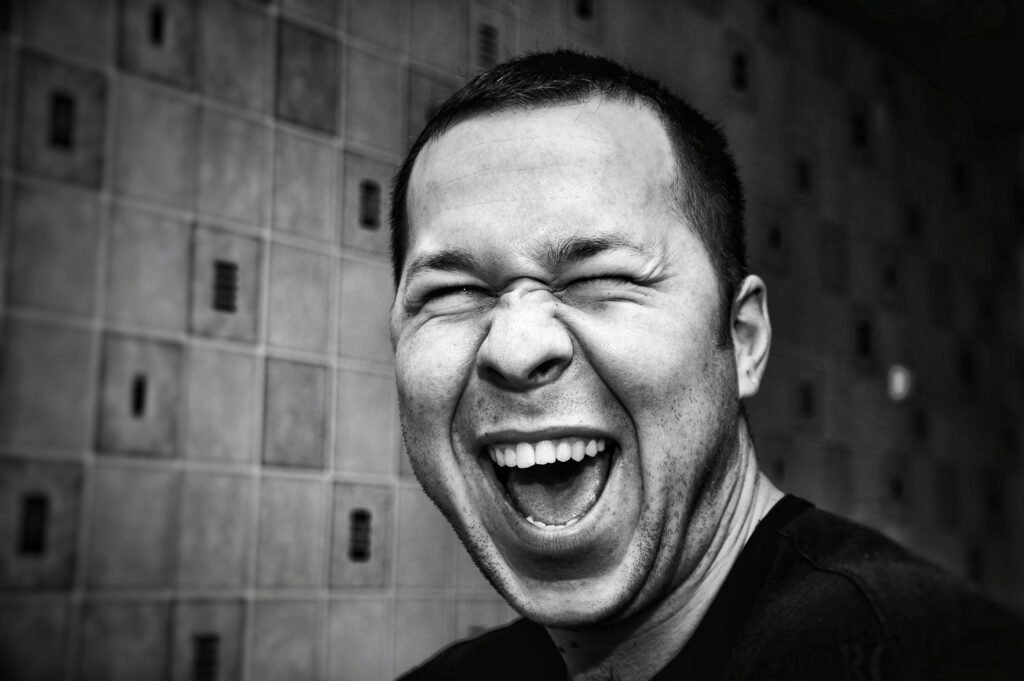
Photo by Denis Agati on Unsplash

Filed Under: Culture, Personal Tagged With: humor