
Part 1: Introduction | Part 2: From the Beginning | Part 3: The Flood | Part 4: The Sabbath | Part 5: Deliverance | Part 6: Isaiah | Part 7: Jeremiah | Part 8: Minor Prophets | Part 9: The Gospels | Part 10: Acts | Pauline Epistles 1 | Part 12: Pauline Epistles 2 | Part 13: Hebrews | Part 14: General Epistles | Part 15: Revelation | Part 16: Job | Part 17: Psalms 1 | Part 18: Psalms 2
Two Psalms, both well known, speak of Creation as revealing the glory of God.
Psalm 8
Psalm 8 begins and ends with a refrain: “O LORD our Lord, how excellent [majestic, glorious] is thy name in all the earth!” The first refrain adds, “Who hast set thy glory above the heavens.” In comparison with those heavens, “What is man, that thou art mindful of him?” (Ps 8.4).
There’s a lot more going on in this Psalm than just this; it repeats the Dominion Mandate from Genesis 1.26-28, and it has Messianic implications as well. But for our purposes, we’ll focus on Creation’s role as a display of the glory of God: his power, his dominion, his greatness.
Those who suppress their recognition of the Creator (Ro 1.18-20) are denied this avenue of worship.
Does the suppression empower the denial, or does the denial empower the suppression?
Good question.
Psalm 19.1-6
1 The heavens declare the glory of God; And the firmament sheweth his handywork. 2 Day unto day uttereth speech, And night unto night sheweth knowledge.
These two verses demonstrate the theme, but of course the thought continues for 4 more verses, which emphasize the global reach of this display of glory, with a special emphasis on the dominant feature of the heavens, the sun, which appears, as David’s simile so artfully paints it, “as a bridegroom coming out of his chamber” (Ps 19.5).
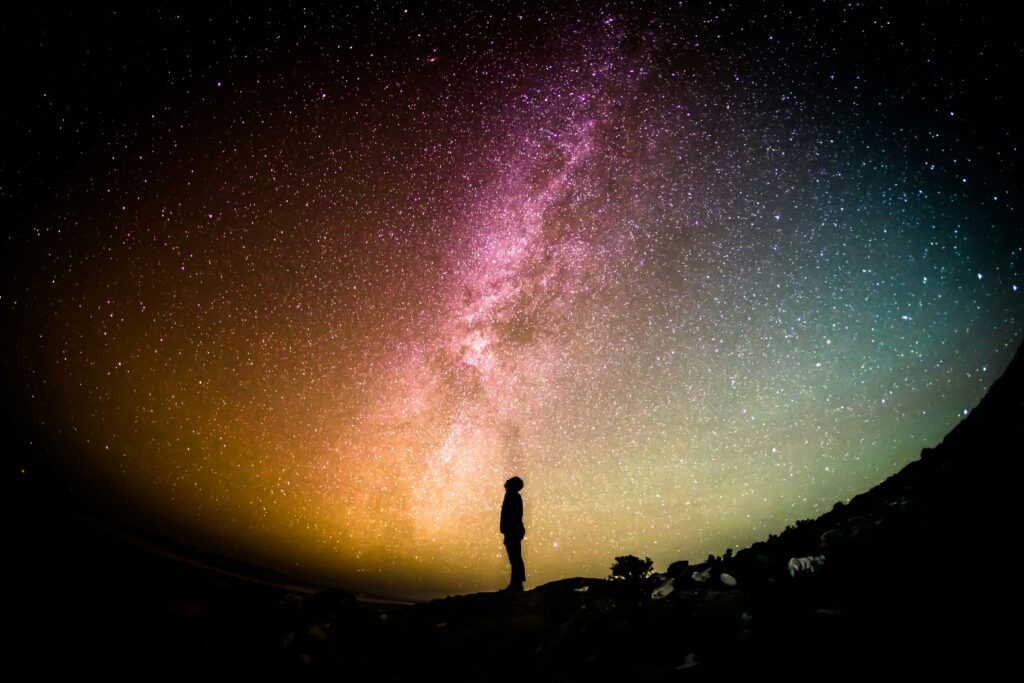
We now know that David’s perspective, 10 centuries before Christ, was but a drop in the cosmic bucket. In the daytime, he had no idea how far the sun was radiating its heat, so far away that the light he was seeing was 8 minutes in the past. He didn’t know how large or hot it was. He was blind to the frequent solar prominences that briefly exceed the size of the earth. At night, even with the advantage of deliverance from light pollution, he could see perhaps a thousand stars, and all of them confined to a single galaxy.
Galaxy? What’s that? He didn’t know that we’re part of a galaxy, the Milky Way. (The Greek word galaxias means “milky.”) He certainly didn’t know that there are more galaxies, millions of them, gathered in clusters, for as far as the very best of our telescopes can see, 50 billion light years in every direction—and that’s not the end of it. He didn’t know about the planets, or their rings, or the asteroid belt, or the heliosphere, or the Oort cloud, or the boundary out there where the molecules are unbelievably hot but feel cold because they’re so far apart.
He didn’t know any of that.
But he was still awed simply by what he could see with his unaided eyes. The Psalm makes it clear that just the sun and visible stars were enough to bring him to his knees.
The Psalm considers the heavens for just 6 verses. The 8 remaining verses turn our attention to a more reliable revelation of God’s glory, the Scripture. The words David uses for it (law, testimony, statutes, commandment, judgments) make it clear that he has in mind the Torah, the 5 books of Moses; that and Joshua may have been all he had access to, besides the songs he was writing.
It speaks volumes that he turns with such focus, respect, and delight to some 500-year-old writings after being so deeply moved by what he has seen in the heavens. We realize that that’s what the heavens should do; they should turn us to the words of the One who made them.
There’s more in the Psalms. Next time.
Part 20: Psalms 4 | Part 21 Psalms 5 | Part 22: Psalms 6 | Part 23: Proverbs | Part 24: Summary
Photo by Greg Rakozy on Unsplash
Leave a reply. Keep it clean.