
Dan Olinger

"If the Bible is true, then none of our fears are legitimate, none of our frustrations are permanent, and none of our opposition is significant."

Dan Olinger


Retired Bible Professor,

Bob Jones University

home / about / archive 

Subscribe via Email

Ruth—Emptiness Filled, Part 10: Eternally Filled

May 6, 2024 by Dan Olinger Leave a Comment

Part 1: Background | Part 2: Loyal Love | Part 3: Chance | Part 4: Abundance | Part 5: A Plan | Part 6: Approach | Part 7: Proposal | Part 8: Affirmation | Part 9: Contract

With the way cleared for Boaz to serve as Ruth’s—and Naomi’s—redeemer, “the elders call down blessings upon him and his bride, and pray that the gracious Ruth will be a mother in Israel such as Rachel and Leah were [Ru 4.11]. This is indeed an optimistic expectation, since these two women as wives of Jacob built up the whole house of Israel, with the assistance of their maids Bilhah and Zilpah” (ECB).

But they go further. They mention “the house of Perez” (Ru 4.12). Why Perez? Well, Perez ”was an ancestor of Boaz (18), and one of only three ancestors of the whole tribe of Judah. Probably most of the local population had descended from him” (NBC).

The comparison is rife with ironic contrast.

  • First, Perez’s birth to Tamar, via Judah, was “a situation in which the levirate responsibility was not honored (Gen. 38)” (TCBC). Judah had failed to care for his daughter-in-law after her husband Er had died. Boaz is a more distant relative to Naomi and Ruth, yet he is fully committed to meeting all their needs.
  • Second, “Tamar achieved her ends through trickery, but Ruth received her son through righteous obedience. … Ironically, the righteousness of a Moabitess, a foreigner to Israel’s covenant, brought salvation to Judah’s family” (HCBC). “Considering the rabbinic hermeneutical principle of ‘from greater to lesser,’ the reader cannot help but think that if Yahweh had given immoral Judah a double blessing in the birth of twins and if Judah flourished through Perez, how much brighter are the prospects for Boaz and Ruth” (NAC).

“This conclusion of the narrative contrasts beautifully with its introduction (1:1–5). Deep sorrow turned to radiant joy; emptiness gave way to fullness” (BKC).

The marriage is followed quickly by fruitfulness in the birth of a son (Ru 4.13). The redeemer who had filled Ruth’s apron with seed for daily bread multiple times now fills her with the sort of seed that will have an eternal impact.* Ruth had had no children during her 10-year marriage to Mahlon; this time will be different. The filling includes not only provision—wealthy provision—but also offspring, and thus a future.

As we might expect, the women of this little village find the birth of this baby a matter for comment (Ru 4.14-15)—and they address their comments not to Ruth, the mother, but to Naomi. They recognize this birth, undistinguished to the earthly eye, as momentous. The baby, not Boaz, is the real redeemer. Mara, the bitter, empty woman, is Naomi again, redeemed, rescued, confident in her secure future.

And the narrative ends with the infant not in Ruth’s lap, but in Naomi’s. She is truly filled. Perhaps the book should be called “Naomi.”

And then the final twist. We learn why this story of poor, apparently insignificant women from a small village is occupying a place in the literature of eternity.

This child of Boaz, and of Perez, is a link in a long chain extending from Abram (Gen 12.1-3)—indeed from God’s “first gospel” in Ge 3.15—to the redemption of a great throng, from every kingdom, tribe, tongue, and nation, who will worship and serve God for all eternity.

We’re not told all that here. But we are told that this infant is to be the grandfather of David, the king, the sweet singer of Israel, whose Greater Son, we know, is the infinite kinsman redeemer, who was made in the likeness of men so that we might be made the righteousness of God in him.

Ruth is a small study of God’s work for us. “The Book of Ruth shows God as concerned not only for the welfare of one family—Naomi and Ruth—but for the welfare of all God’s people who would be blessed by David and by David’s Son, Jesus Christ. The participation of Ruth, the Moabitess, in the fufillment of God’s promises indicates that God’s salvation is for people of all nationalities” (HCBC).

“Hosanna! Blessed is He who comes in the name of the LORD!”

* For this insight into the thematic development of Ruth I am indebted to the late Dr. Ron Horton, longtime professor of literature at Bob Jones University.

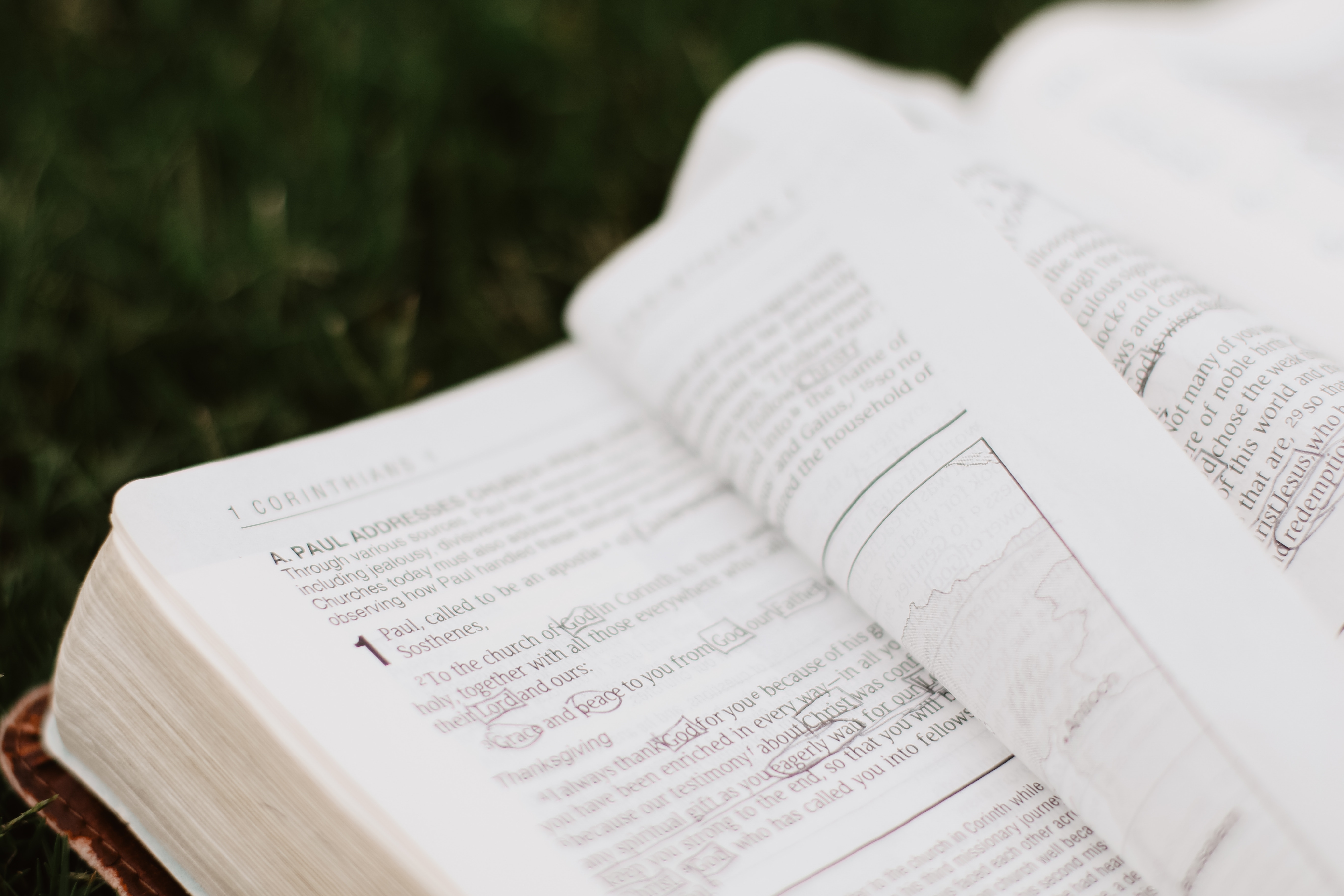
Photo by Paz Arando on Unsplash
Filed Under: Bible, Uncategorized Tagged With: Old Testament, Ruth

Ruth—Emptiness Filled, Part 8: Affirmation

April 29, 2024 by Dan Olinger Leave a Comment

Part 1: Background | Part 2: Loyal Love | Part 3: Chance | Part 4: Abundance | Part 5: A Plan | Part 6: Approach | Part 7: Proposal

For now, Ruth will stay at the threshing floor with Boaz until daylight approaches. “Why did Boaz tell Ruth to remain with him that night [Ru 3.13], potentially compromising her virtue, rather than sending her home immediately? In view of the general lawlessness and social disruption that characterized the period of the judges (cp. Jdg 21:25), sending Ruth home alone late at night would have placed her life in danger” (ASB).

But she will leave before she can be recognized; “Boaz took precaution against scandal ([Ru] 3:14), which showed that he already was functioning as Ruth’s protector” (TCBC).

And as he sends her home at daylight, he demonstrates again his determination to function as her provider as well. Into her held-out cloak he pours “six measures” of barley grains (Ru 3.15). The six “measures” were probably 6 omers, 6/10 of an ephah (Ex 16.36) or about 25 pounds. Again, she probably carried the bundle home on her head. “If someone should spot her that morning it would appear that she had merely gotten an early start on the day’s work by transporting this sizable allotment of grain from the threshingfloor to her quarters” (Smith, OTSS).

When Ruth reports it all back to Naomi (Ru 3.16-17), the wise older woman reads Boaz’s intentions well (Ru 3.18).

So is God keeping covenant with this “empty” woman? Is He filling her again?

  • He has brought her home just as food becomes abundant.
  • He has led her foreign daughter to one of just a few men who are legally qualified to help her in a substantial way—and he is wealthy enough to act on the qualification, and kind enough to be willing to help.
  • He has revealed Boaz to be an honorable man, and a humble one, who is surprised that the beautiful Moabite would even ask him for redemptive marriage.

Her reactions to this point tell us that she recognizes what the Lord is doing to refill her empty life.

  • She knows immediately that Boaz, the owner of the “random” field, is “one of our next kinsmen” (Ru 2.20) and a man of hesed.
  • She knows that Ruth will be well protected if she stays in his field for the harvest season (Ru 2.22).
  • She knows that Boaz will likely respond honorably to Ruth’s plea for redemption and will not take advantage of the private meeting in the middle of the night (Ru 3.1-4).

 Could there possibly be more? Of course; would God do this much and leave her still effectively empty? Certainly not.

 And what of us?

 Will this God honor His promises to you?

  • Will He receive you in spite of your sin?
  • Will He meet your physical needs?
  • Will He hear your prayers?
  • Will He bring you safely home?

 What do you think?

Photo by Paz Arando on Unsplash

Filed Under: Uncategorized

On Sources for the Bible, Part 2: Specifics

February 7, 2024 by Dan Olinger Leave a Comment

Part 1: Summary

In the previous post I observed that the biblical writers often used other works as they composed their writings—and that they didn’t confine themselves to other biblical works.

Here are the specifics.

I like to organize these references into 2 categories:

  • Consultation, by which I mean that the author says, “This is also recorded in such-and-such a document.”
  • Allusion or quotation, where the author quotes, loosely or directly, from another source, whether he specifies it or not.

First the consultations.

Jewish Sources

  • Book of Genealogies (Gen 5.1)
  • Book of Jasher (Josh 10.13; 2Sam 1.18)
  • Book of Nathan the Prophet (1Ch 29.29; 2Ch 9.29)
  • Prophecy of Ahijah the Shilonite (2Ch 9.29)
  • Visions of Iddo the Seer (2Ch 9.29; 12.15; 13.22)
  • Book of Shemaiah the Prophet (2Ch 12.15)
  • Book of the Acts of Solomon (1K 11.41)
  • Book of Gad the Seer (1Ch 29.29)
  • Sayings of the Seers (2Ch 33.19)

Note that two passages, 1Ch 29.29 and 2Ch 9.29, are particularly rich in these consultations.

I also note that these sources cannot be divinely inspired, since they have not been preserved, as God promised that his Word would be.

A Persian Source

  • The author of Esther (perhaps Mordecai?) consulted “The book of the chronicles of the kings of Media and Persia” (Es 10.2)—perhaps in the same warehouse where the unnamed servant grabbed a clay tablet at random to read to Xerxes so he could sleep (Es 6.1).

And now the allusions and quotations. Where possible I’ve included links to the sources on the internet so you can check ‘em for yourself.

Jewish Sources

  • Book of the Wars of the Lord (Num 21.14; cf Ex 17.14)
  • Jannes and Jambres (2Tim 3.8)—text not available online
  • Martyrdom of Isaiah 1.9-10, 5.11-12 (Heb 11.37)
  • Assumption of Moses (lost fragment) (Jude 9)
  • 1 Enoch 1.9 (Jude 14-15)
  • 1 Enoch 21.10 (?) (2Pt 2.4)

Pagan Sources

  • Aeschylus, Agamemnon l. 1915 / 1624 (Acts 9.5)
    • This is included in Jesus’ words to Paul from heaven. Jesus’ sentence is clearly the same as the line from “Agamemnon,” but we can’t be certain that Jesus is quoting that poem. It’s possible that Aeschylus’s line became common in the ancient culture—similar to, say, “Early to bed and early to rise”—and Jesus is simply referring to the popular expression.
  • Epimenides, Cretica (Acts 17.28a; Titus 1.12-13)
  • Aratus, Phaenomena l. 5 (Acts 17.28b)
  • Menander, Thais 218 (1Cor 15.33)

So What?

What does all this mean?

  • The Spirit-driven biblical writers used sources, including pagan sources, with no apparent discomfort.
  • They did so using the standard practices of their day; for example, Paul uses a couple of lines about Zeus and applies them to the Lord. The hearers would be expected to understand what he was doing, and there was no intent to deceive.

Here’s what it doesn’t mean. It doesn’t mean that the source is inspired. We do not “live, and move, and have our being” in Zeus.

One closing note.

Jude cites 1 Enoch in his epistle. Now, we know that the biblical Enoch is not the author of everything in 1 Enoch—but there’s no reason that the traditions on which 1 Enoch is based couldn’t have included some authentic statements of the ancient saint. If Jude had simply cited 1 Enoch without any comment, it wouldn’t matter whether or not what he quoted was actually spoken by Enoch. But he puts it this way:

And Enoch also, the seventh from Adam, prophesied of these, saying … (Jude 14).

In my opinion, Jude is stating that the historical Enoch, seven generations from Adam (and long before “1 Enoch” was written), said these words. And since Jude is inspired, I believe that the verse he quotes from 1 Enoch is in fact an authentic saying of the ancient prophet.

Have fun with all this.

Photo by madeleine ragsdale on Unsplash

Filed Under: Uncategorized

On Seeing God

December 18, 2023 by Dan Olinger Leave a Comment

I ended my previous post by noting that although Moses was not allowed to see God’s face, God’s people will eventually see him. I’d like to meditate further on that.

In mentioning Moses I was referring to the well-known incident at Sinai, where Moses asked to see God’s face and was denied; God instead placed him in a fissure in the rock and, as he put it, covered the fissure with his hand, removing it just so as to allow Moses to see his “back” (Ex 33.17-23).

This occurred after Moses, Aaron, Nadab, Abihu, and the 70 elders of Israel had gone up on Mount Sinai “and saw the God of Israel: and there was under his feet as it were a paved work of a sapphire stone, and as it were the body of heaven in his clearness. And upon the nobles of the children of Israel he laid not his hand: also they saw God, and did eat and drink” (Ex 24.9-11). Immediately after that, the others returned to the camp while Moses and Joshua went further up the mountain, “and the glory of the Lord abode upon mount Sinai, and the cloud covered it six days: and the seventh day he called unto Moses out of the midst of the cloud. 17 And the sight of the glory of the Lord was like devouring fire on the top of the mount in the eyes of the children of Israel. 18 And Moses went into the midst of the cloud, and gat him up into the mount: and Moses was in the mount forty days and forty nights” (Ex 24.16-18). During those 40 days, God gave Moses instructions about the tabernacle and the priesthood (Ex 25-31).

And because of the apparent delay, the people worshiped a golden bull idol, and Moses, returning, broke the tables of the Law in his rage (Ex 32). In the succeeding days he met with God, “face to face” (Ex 33.11), and it was here that he asked to see God’s “glory” and was denied.

But then God instructed him to return to the mountain, where “the Lord passed by before him” (Ex 34.6) and revealed himself with the classic wording that is repeated throughout Scripture. On his return from the mountain, his face “shone” so much that he covered it when he spoke with the people (Ex 34.29-35).

God revealed himself to Moses in unprecedented and spectacular ways, even as he refused to show him his “face.”

Interestingly, six centuries later the prophet Elijah had a similar experience in the same place.

He was running from Jezebel, running for his life. He hid in a cave—another sort of fissure—and the voice of God commanded him to step out and stand in the open. There “the Lord passed by” to the sound of a mighty wind, “but the Lord was not in the wind” (1K 19.11). Then followed an earthquake, and then a fire, but the Lord was not in them either. And finally, as we all know, “a still small voice” (1K 19.12)—a voice that commissioned him for his next ministry, and a significant one.

And these two men, Moses and Elijah, were summoned to a different mountain centuries later, a “high mountain” in Israel, to see the shining face of God in another way, a better way, at the Transfiguration (Mt 17.1-8). There they communed with Jesus, the Word of God, the perfect expression of the Father (He 1.3), the one who said, “He that hath seen me hath seen the Father” (Jn 14.9). They spoke face to face, discussing Jesus’ coming “exodus,” the pivotal event in the history of the world.

They saw, and they knew.

And they were safe.

As my previous post noted, we, too, shall see him, and we shall even be like him (1J 3.2). We will no longer see as now, in a mirror, dimly (1Co 13.12).

May that day soon come.

Photo by Aaron Burden on Unsplash

Filed Under: Uncategorized

On Providence, Part 5: And Esther

August 7, 2023 by Dan Olinger Leave a Comment

Part 1: Where? | Part 2: How? | Part 3: Joseph, For Example  | Part 4: And Naomi

No one tells the story of God’s providence better than the author of the Book of Esther. I did a fairly lengthy series of posts on that story a year or so back. You can read that series here.

Part 6: And the Seed of the Woman

Photo by Katie Moum on Unsplash

Filed Under: Uncategorized

  • « Previous Page
  • 1
  • 2
  • 3