Dan Olinger

"If the Bible is true, then none of our fears are legitimate, none of our frustrations are permanent, and none of our opposition is significant."

Dan Olinger


Retired Bible Professor,

Bob Jones University

home / about / archive 

Subscribe via Email

7 Stabilizing Principles in a Chaotic World, Part 3

July 19, 2018 by Dan Olinger Leave a Comment

Part 1 Part 2

Number 2: Image of God. Everyone is infinitely valuable. Treat him that way.

God not only runs the world; he created it. From scratch. (Google ex nihilo sometime. The official meaning is “from scratch.”) All of it. Everything is from his hand, originally.

But not everything is of equal value. He created light, and darkness, and water, and dirt, and plants, and animals. They’re all worth something, because he decided they’re worth creating.

But humans are different. In the creative process, the creator set them apart. He did so in many ways—by creating them last, climactically; by eagerly anticipating what he was about to do; by getting his hands dirty in the act of creating them. And most clearly, by speaking of them as specially gifted—they are, he said, “In our image, after our likeness” (Gen 1.26-27).

You’re in the image of very God. You’re not God, but you’re like him in some ways, and that makes you infinitely valuable.

Now, we’re all fine with that part. But here’s the thing—every other human is like that too. The people you like, sure; but the people you dislike as well. Even the people you hate.

When Noah left the ark after the flood, God established a system of human government, including capital punishment; he gave Noah, and by extension other humans, the right to kill murderers. This is the same God who later told Moses, “You must not kill!” (Ex 20.13). Is God unstable? Self-contradictory? Forgetful?

Of course not. God gave a reason why murderers could be killed while others must not be: the murder victim was in the image of God (Gen. 9.6).

Now, that’s really interesting. Sometimes murder victims get killed for no reason. But sometimes they don’t. Sometimes there’s a very good reason–or at least an incitation. My great-grandfather Olinger was murdered in Missouri, back in the 1800s, in a dispute with his neighbor over water rights. The details of the story haven’t been preserved for my current family members, but I’ve often wondered if he did something to provoke his neighbor, in word or deed. Sometimes that happens.

Sometimes murder victims, well, kinda have it coming.

But God says the murderer still gets executed, because that murder victim, distasteful and unlikable and rage-inducing as he may have been, was in God’s image.

Broken, sinful, perhaps—from all outward appearances—worthless. But also in the image of God.

The implications of that are far-reaching.

The homeless person is of unlimited value. Even if he’s homeless because of his own stupid inattention to personal responsibility.

The illegal immigrant is of unlimited value. Even though he’s broken the law.

The political enemy is of unlimited value. Even though he’s obviously an idiot. And eeeevvvviiiillll.

Now, suppose I pay a visit to the United Kingdom, and I see a bust of the Queen, and I spit on it. (All my British friends, please bear with me for a moment.)

I’m going to get a response. It might be just a cocked eyebrow. Or it might be a verbal rebuke from a passerby. Or, more likely, it just might be a visit from a bobby.

Why? It’s just a piece of rock!

Well, no, it isn’t. It’s a piece of rock that happens to look like the Queen, God save her, and spitting on the image of the Queen is going to get you in a lot of trouble, deservedly, from the Queen’s devoted subjects.

So when you treat God’s image with disrespect, what do you think is going to happen?

If you ignore the plight of the homeless, or the need of the illegal immigrant, or if you treat your political opponent with disrespect, these actions are not without consequence. The God of heaven sees, and he knows, and he cares, and boy, you’re in a heap of trouble.

Now, this all screams for a disclaimer, the one you’re eagerly waiting for. There are ways to address the needs of the homeless without forcing taxpayers to foot the bill, and without being wasteful or creating dependency. And illegal aliens have broken the law, and there are consequences for that. And your political opponent might well have no idea what he’s talking about; that has happened. I’m not saying that socialism or lawlessness or moral relativism are necessary consequences of the image of God in humans.

But I am saying that the image of God matters, and that at the interpersonal level, you need to treat everybody—everybody—with that kind of respect.

If you’ll see all those around you in that light, the way you feel about them will change. And so will the way you respond to them on social media.

Frankly, I doubt that the chaos of the current culture will go away just because your perspective has changed.

But it’s a start.

Part 4 Part 5 Part 6 Part 7 Part 8

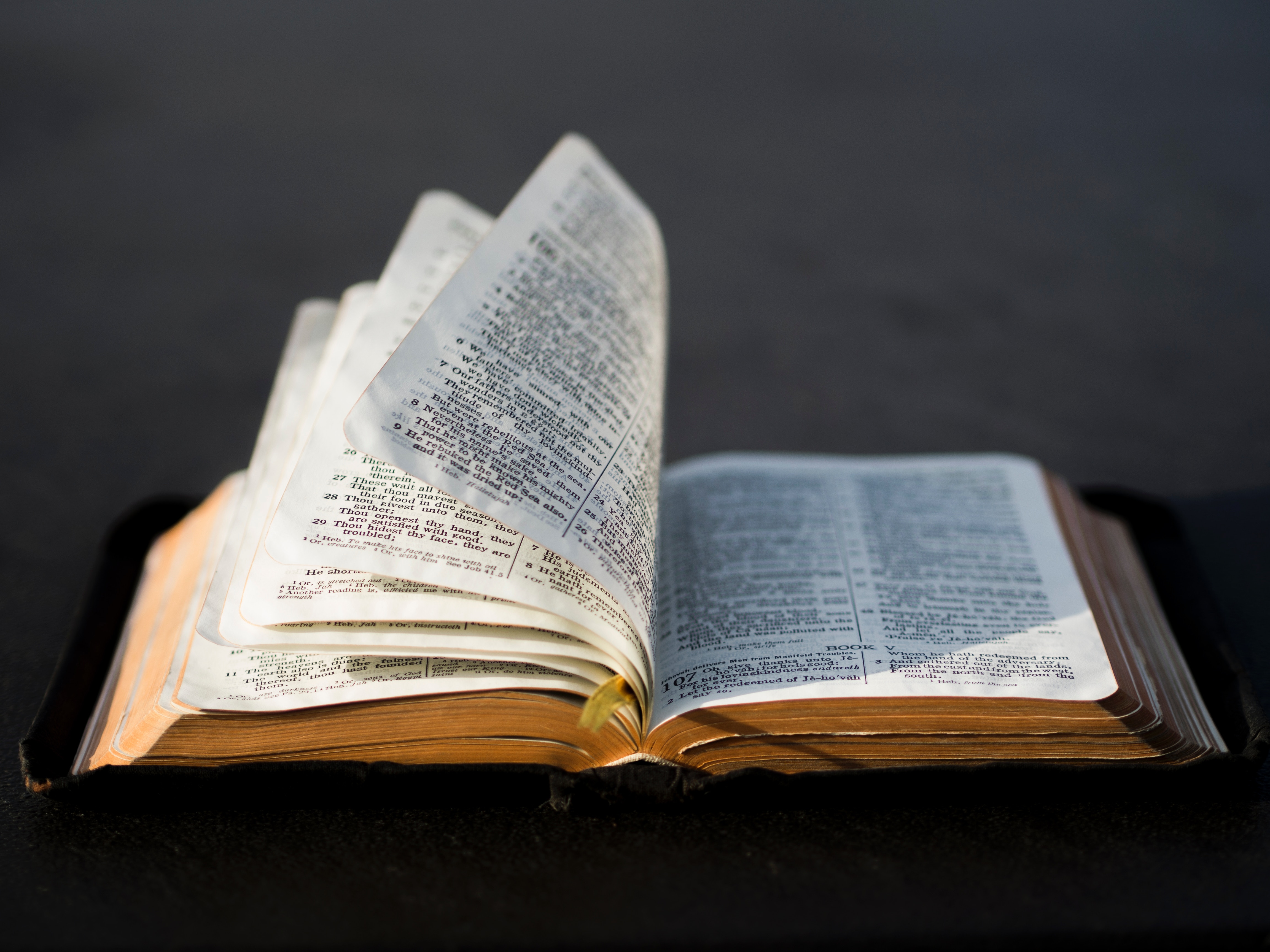
Photo by Keith Misner on Unsplash

Filed Under: Bible, Culture, Politics, Theology Tagged With: image of God, theology proper

On Existential Providence

March 12, 2018 by Dan Olinger Leave a Comment

God’s in charge.

He’s sovereign; his will is always accomplished. That includes the big things, and the tiny little things. In my case, tiny little things brought existential results: I wouldn’t exist without them.

My Mom grew up in Brockton, MA, the daughter of hardworking and really interesting Universalists. On graduation from high school, she went to secretarial school and then moved to Baltimore during World War II to work some sort of secretarial job. She got an apartment with a roommate named Nikki.

Dad grew up in the Pacific Northwest, born in Salmon, ID. By age 13 he’d lost both of his parents, and he finished his youth under the freewheeling stewardship of his older siblings, mostly in Spokane, WA, and LA (where he experienced the Long Beach earthquake of 1933). Around 1944 he volunteered for the Army, mostly, I suspect, to get out of the house. Basic training at Camp Roberts in California, then off on a troop ship to the Philippines, as a replacement soldier for the combat-depleted 31st “Dixie” Division, known today as the Alabama National Guard. Spent time on both Leyte and Mindanao, with little combat; made a little extra money by cutting other soldiers’ hair in the jungle.

When the war ended, he returned Stateside and was sent to Fort Meade, MD, during the last days of his enlistment.

One weekend he got a pass and went into Baltimore.

I dunno, I think I’d have gone to Washington. But he went to Baltimore.

He and a buddy or two dropped in to a café to get something to eat. As they were getting seated, Dad noticed another couple of soldiers making a clumsy pass at two girls who were paying their bill at the register. The girls clearly didn’t want to talk, but the guys kept trying.

Dad got up and told them to knock it off. We can all see they don’t want to talk to you; leave them alone, and get out.

They were privates. Dad was a corporal. They got out.

Dad said a few words to one of the girls. Yeah, she was my Mom.

And 8 years later, along came Yours Truly.

So for me, this is really an existential story. I wouldn’t be here if that hadn’t happened. And oh, yeah, neither would my sisters.

What are the odds?

How did a boy from Idaho, 2 miles down from the Continental Divide, end up in the Philippines with a unit from Alabama?

And how did he and the future Mrs. O. end up in Baltimore, where neither of them had ever been before, at the same time for completely unrelated reasons?

And how did they end up at the same hole-in-the-wall café on supper shifts that overlapped by about 10 minutes?

What if he’d come to supper 15 minutes later?

What if a couple of jerks hadn’t hassled the girls on their way out?

What if?

Our lives are an endless stream of details, winding in and out of other endless streams, sometimes apart, but occasionally intersecting. And those intersections are usually brief and trivial and quickly forgotten. What was the name of the guy you greeted on the way into the drugstore yesterday afternoon?

But sometimes those intersections change lives, and those times they change all the world for the people involved.

And God oversees and directs the whole symphony.

The God who raises up kings and sets them down again, who empowers the existence and continuance of the whole universe, who sees that the water cycle and the seasonal cycle continue despite our attempts to contort and convolute them, this God engineers the tiny little details as well.

The tiny little trivial ones, and the tiny little existential ones.

I’m glad of that.

Photo by David Marcu on Unsplash

Filed Under: Theology Tagged With: providence, theology proper

On Calling God by His First Name

November 16, 2017 by Dan Olinger 3 Comments

God has a lot of names.

And they’re significant, for two reasons: first, because unlike us, God has chosen his names for himself; and second, because he has chosen to reveal his character and works through them.

And so he has a lot of names, because there’s a lot to know about him.

Some of his names are simple and straightforward. Elohim (in the Old Testament) and Theos (in the New Testament) simply mean “God.” Adonai (OT) and Kurios (NT) simply mean “Lord.”

Some of them are more complicated. Yahweh Tsebaoth (OT) means “Lord of Hosts” or “Commander of Armies”; the name speaks of his ability to back up his plans and commands with a powerful heavenly host of battle-hardened troops—even though he’s omnipotent and doesn’t really need the help.

And that brings us to the name Yahweh, or more correctly YHWH, which we typically translate as “LORD.”

And that’s a shame. Let me explain why.

First, a little background.

Unlike the other names of God, which are titles or descriptions, YHWH is God’s personal name; in Western culture we would say that it’s his “first name.” And remarkably, God reveals that name to his people and invites them to use it when referring to him.

Imagine that. God invites his people to call him by his first name.

But of course, God is God, the Creator of heaven and earth; we may do whatever he invites us to do, but we may not treat him as common. He is holy; we treat him not just with respect, but with a respect unlike any other. And so he tells his people, “You must not take my name in vain” (Ex 20.7); that is, you may call me by my first name, but only respectfully. This relationship is not trivial, and it is not a joke.

When the Hebrew OT was written, scribes did not include vowels; they wrote just the consonants, and part of being literate was knowing the text well enough to know what the unwritten vowel sounds were. (That’s why it was—and still is—such a big deal for a Jewish boy to read aloud from the Torah, in public, when he became a man at bar mitzvah.)

At the same time, the Jews were very careful to keep all the commandments, and even to put protections in place to prevent themselves from violating a command accidentally. God had said not to take his name in vain; eager to please, the Jews thought they would safeguard against taking the name in vain by never taking it at all.

And so, when the public reader of Scripture came to the name YHWH, he would not pronounce it; he would read Adonai (Lord) instead. Centuries later—long after Christ’s death, in fact—when Jewish scribes called Masoretes added vowels to the OT text, to every occurrence of YHWH they added the vowels for Adonai as a reminder to the reader to say the latter, not the former. (And thus, to this day, we’re not sure how to pronounce the name—the name by which he invited us to call him.)

And then the word looked like “Yehowah.” Centuries later, when biblical scholarship passed through Germany, those scholars wrote that pronunciation as “Jehovah,” and a new name was created. (Interestingly, the name that the “Jehovah’s Witnesses” approve for God is in fact the one name that we know for sure is not actually a name for God (!).)

A thought. Do you like to hear your name? Of course you do. Often, in an introduction, your name is the only one you hear. :-) What do you think God thought when his own people refused to speak his name? And all out of respect?

I wonder in what other ways we choose to show our respect for God in ways that hurt him.

In another development, a group of Jewish scholars translated the Hebrew scriptures into Greek a couple of centuries before Christ. In a far-reaching decision, they chose to translate the Hebrew YHWH with the Greek kurios, “Lord”—even though they were already using that Greek word to translate Adonai—I suppose because the public reader would read “Adonai” whenever he saw YHWH anyway.

So now, we’ve replaced God’s first name with a title.

What does that do?

It distances us from the person.

Some people call me “Dan”—some few even call me “Danny.” (They would be my older sisters, in whose minds I am still an obnoxious little boy.) Others call me “Dr. Olinger.”

Which ones do you think I’m closer to?

God has asked us, his people, his sons and daughters, to call him by his first name. And we call him “LORD” instead. We hold him at arm’s length when he seeks an embrace.

How do you think he feels about that?

I’m not suggesting that we burn all the Bibles that have “LORD” in all caps. But we should at least remember that God has called us to an intimate relationship with him; he has invited us to come boldly and joyfully into his presence, as the little children came to Jesus.

We should delight in that degree of loving, respectful intimacy as much as he does.

Photo by Ben White on Unsplash.

Filed Under: Theology Tagged With: theology proper, worship, YHWH

  • « Previous Page
  • 1
  • …
  • 7
  • 8
  • 9