
Part 1: Introduction | Part 2: The Days of Abraham | Part 3: Egypt
The Bible records that after the Exodus from Egypt and the Wilderness Wanderings in Sinai, Moses died before the Israelites, under Joshua’s leadership, conquered the Canaanite tribes and settled into their allotted tribal areas.
There are a couple of archaeological sites that connect the biblical story of the conquering of Canaan with “secular” history.
Ugarit
Ugarit was a major city on the Mediterranean coast just north of the Phoenician capital of Tyre, in modern Syria. It was there for a long time, but most of what we know from the site is from the Bronze Age, up to about 1200 BC. Ugarit was apparently at its peak between 1500 and 1200 BC. This coincides nicely with the conquest of Canaan by Joshua and by the succeeding period of the judges.
The site has yielded a wealth of cuneiform tablets, written in a language (“Ugaritic”) similar to Hebrew in some ways but distinct from it. These tablets describe trade and political relations across the Ancient Near East, particularly with Egypt. There’s even a letter from Merneptah (remember him?).
But the site’s two most significant contributions to biblical studies are in religion and language. There are numerous references to Baal and Dagan, with descriptions of religious practices that illuminate the reasons that God saw the Canaanite religions as reprehensible.
Ugaritic has also helped greatly in our understanding of Ancient Near Eastern languages. An example that I particularly like has relevance to 1 Samuel 13.21. The verse describes a problem the Israelites had with making weapons: they had to go to the Philistines to get their tools sharpened, and of course the Philistines wouldn’t sharpen any tool with a military application.
Here the KJV says, “They had a file for the mattocks.” The Hebrew word translated “file” is pim, and nobody had any idea what it meant. Working off the context, the KJV translators guessed that the Israelites had their own tools for sharpening their farm implements. But the word pim shows up in Ugaritic: it’s a monetary value, about 2/3 of a shekel. So the verse says that the Israelites had to pay that fee for getting a tool sharpened. The modern English translations, published after the archaeological work in Ugarit, reflect that understanding.
Deir Alla
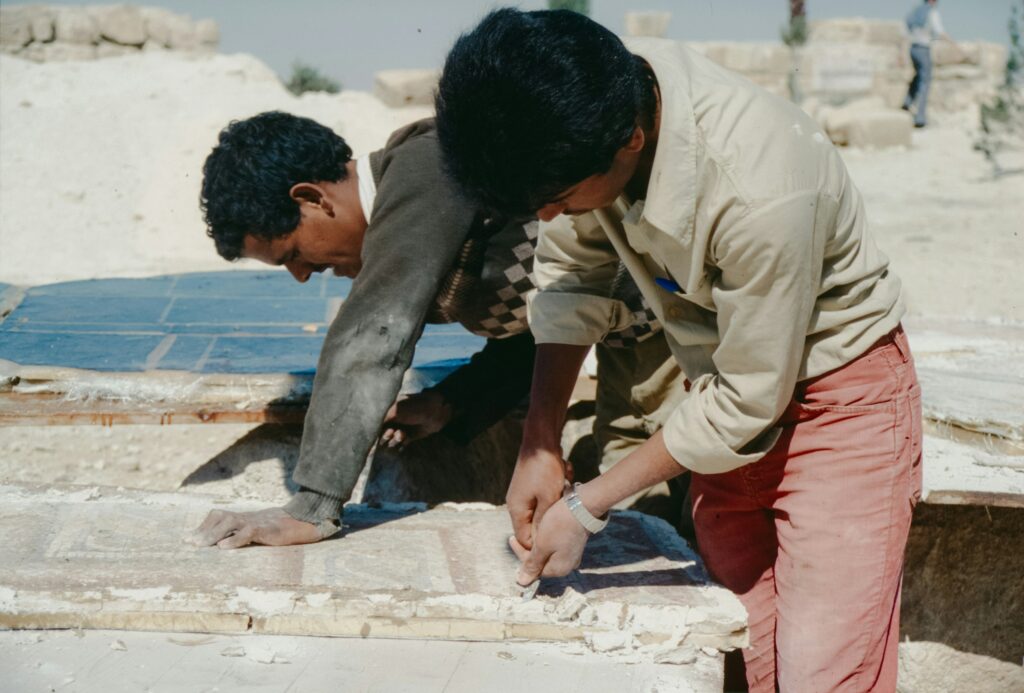
Deir Alla is an archaeological site on the east side of the Jordan, about midway between the Sea of Galilee and the Dead Sea. The site includes a wall that collapsed, likely from a tremor. We know that the area suffered a major earthquake during the reign of Jeroboam II in the mid-8th century BC (Amos 1.1), so that’s interesting.
But what’s really interesting is that the wall contains an inscription, written in red and black ink on plaster. This inscription records “the book of Balaam, son of Beor, a seer of the gods.”
As you might expect, the inscription is not in good shape, and there are words missing and writing that is not completely unambiguous. But the great majority of scholars, conservative and liberal, agree that this is a reference to the biblical Balaam.
Interestingly, the inscription does not include the prophecy recorded in Numbers 23 and 24. But the inscription’s existence argues strongly for the historical existence of this prophet, and the details coordinate nicely with how the biblical account describes him.
Next time, we’ll proceed to the time of David.
Photo by Annie Spratt on Unsplash
Leave a reply. Keep it clean.